Comparison
Kode Dot vs Flipper Zero: an honest comparison, written by the people who make one of them
We make one of these two devices, so read this the way you would read anything written by a competitor. The concessions come first and they are detailed: where the Flipper Zero is the better buy, this page says so before it says anything else. Every figure here was checked against a primary source on 31 July 2026, and each one is dated because most of them will rot.
The short answer
For most people typing "Kode Dot vs Flipper Zero" into a search box today, the answer is buy the Flipper Zero. We make the other one, and that is still the correct advice for the majority of you.
The reasons are boring and decisive. The Flipper Zero exists: it ships in 2 to 5 business days from the Netherlands and 1 to 3 days from Los Angeles, for $199 in the US or EUR 219 in the EU on Flipper's own store. Sub-GHz is in the base device at the base price, along with NFC, 125 kHz RFID, infrared and iButton. There are 413 apps in the official catalogue, three community firmwares, and Flipper states more than one million users. The Kode Dot is a pre-order at EUR 169: our EU and UK batch is scheduled for November 2026 and our US batch for January 2027. If you want a working multitool this month, nothing further down this page changes that.
Keep reading if you are in one of two situations: you want to write software rather than run signals, or you already own a Flipper and want to know whether a second device earns its place. Those are the only two cases where we think we are the better answer, and we will be specific about why.
Why we can write this at all
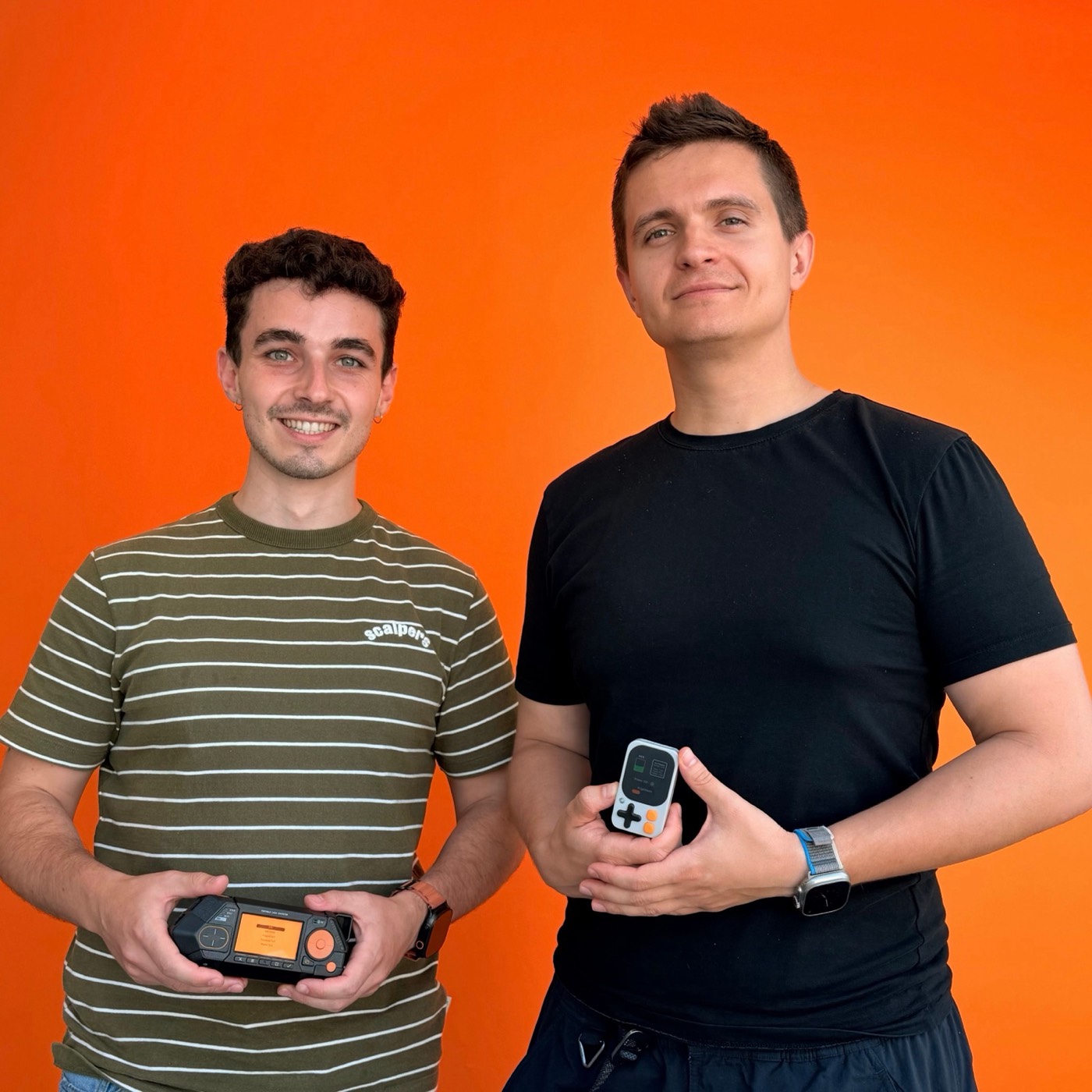
Quero was in London for something else entirely. He sent a DM to Pavlo Zhovner from the airport, mostly not expecting a reply, and got invited over that Sunday in June 2026.
He walked in nervous, because we had already published a video putting the two devices head to head. What he got instead was a tour of their hackerspace and about three hours of conversation: manufacturing, defect rates, why the sub-GHz decision is harder than the internet thinks, what it costs to get a device legally into more than a hundred countries. Pavlo talked about the parts of the job that do not photograph well.
That afternoon raised our standard for this page, and nothing beyond that. Flipper Devices has not reviewed or approved a word of this comparison, and none of the conclusions below rest on a Sunday afternoon; they rest on figures that are dated and checkable, and you should treat them that way.
Where the Flipper Zero leads
Start with the argument that has settled this comparison for more than four years: the Flipper Zero exists, and you can be holding one on Thursday. It ships in 2 to 5 business days from the Netherlands and 1 to 3 days from Los Angeles, and it has been shipping since March 2022. A commenter on r/HowToHack put it in one sentence we cannot fault: "Since the Flipper Zero is the only one of those that currently exists in the wild, I'd go with the flipper." Our next EU and UK batch is scheduled for November 2026 and the US batch for January 2027. That gap is real.
Sub-GHz is in the base device at the base price. A TI CC1101 with RX across 300 to 348, 387 to 464 and 779 to 928 MHz, a frequency analyzer and RAW capture, for $199 or EUR 219, with transmission gated to the civil bands your region permits. On the Kode Dot that radio lives on the hacking module, sold separately, and we took the criticism for it on our own subreddit: "Of all the functions on my Flipper, I use it the most, so this is disappointing." Owners in that thread told us the opposite of what our own unpublished survey said, and their testimony beats that survey, so we are not going to lean on it here. The decision rule stands: if sub-GHz is why you are buying, Flipper has it in the box and we do not.
Then there is the part no company can manufacture, which is other people. The official catalogue holds 413 apps, 405 of them built against the current SDK, spread across 106 GPIO tools, 99 games and 88 utilities. Three community firmwares carry the rest: Unleashed at 21,949 stars with a release on 30 July 2026, RogueMaster at 6,302, and Momentum at 8,960 with no release since December 2025 and no recent commits, on which its maintainers have said nothing. r/flipperzero has 274,144 members and the official Discord 116,199, both read on 31 July 2026, against Flipper's stated figure of more than one million users. On 1 July 2026 Flipper Devices moved the official firmware into maintenance mode and handed feature growth to the community (Flipper Devices blog, 1 July 2026); the community picked that up within the month, the catalogue is still accepting submissions, and a product arriving at done is a legitimate state rather than a decline.
Some of Flipper's advantages are simply hardware we do not have. iButton is the clearest: Dallas DS199x, DS1971, Cyfral, Metakom, TM2004 and RW1990 keys, read, saved, written and emulated on dedicated pogo pins. In much of Eastern Europe those are the intercom keys people actually carry, and the Kode Dot has no 1-Wire contact interface, so the capability is absent rather than worse. Documentation counts too: Flipper publishes roughly twenty named 125 kHz card families, so a buyer can check whether their building fob is likely to respond before spending anything. We publish no such list, and for the person asking "will it work on mine?", that is a present, practical disadvantage regardless of what our silicon can do.
The battery row goes to them. 2100 mAh driving a 1-bit 128 by 64 LCD whose entire framebuffer is 1 KB, with a stated runtime of up to 28 days. The same discipline runs through the whole design: one screen, a D-pad, a back button, no mode confusion, no charging anxiety. Being simple is a design achievement, not a limitation waiting for someone else to fix, and the reliability people love in the Flipper is downstream of it.
Finally, the unglamorous four years. A versioned SDK frozen at 1.0 so developers stopped rebuilding their apps every month, with every app checked against an API version and a 10 by 10 pixel icon spec that keeps the whole asset pipeline tractable for a small team. A 10 to 50 KB app installs in seconds from a phone over Bluetooth, or from lab.flipper.net over Web Serial, with no computer required. FCC ID 2A2V6-FZ, region gated transmission, and in Flipper's own words heavy investment in "regulatory certifications, customs approvals, and all the paperwork required to officially import Flipper Zero into most countries". All of that is behind them and ahead of us. And they delivered: $4.88 million raised in 2020, first units in March 2022, about 90% of Kickstarter orders shipped by July 2022, and the delays explained publicly and specifically. In this category that record is an asset, and ours is still a promise.
The rows that decide most purchases today, and most of them go to Flipper. Figures checked 31 July 2026. Nothing in this table credits the Kode Dot with the add-on hacking module: where that module matters, the base device cell says so plainly.
Availability
- Kode Dot
- Pre-order. EU and UK batch November 2026 (February 2027 queued), US batch January 2027 (April 2027 queued).Our windows are scheduled batches as of 31 July 2026, not guarantees. The Kode Dot product page is authoritative; if the dates move, it moves first and this page follows. No Kode Dot is in a customer's hands yet, which is the single biggest difference between the two devices.
- Flipper Zero
- In stock. Flipper Zero ships in 2 to 5 business days in the EU and 1 to 3 in the US, and has shipped since March 2022.
Sub-GHz radio
- Kode Dot
- None. The base Kode Dot has no sub-GHz radio at any price.Add-on hacking module, sold separately: a CC1101 with three bandpass filters and two synchronised SP3T switches. We have not published that module's price or ship window as of 31 July 2026, so no radio for radio total can be computed from this page.
- Flipper Zero
- TI CC1101 in the base device: RX across 300 to 348, 387 to 464 and 779 to 928 MHz. TX only on the civil bands your region permits.
Bluetooth and phone tooling
- Kode Dot
- Not published. We have published Wi-Fi, Matter, Zigbee, Thread and ESP-NOW for the ESP32-C5, and no Bluetooth figures, so we print none.No Kode Dot companion mobile app has been announced either. This is a row Flipper wins outright and it belongs in the table.
- Flipper Zero
- BLE 5.4, 4 dBm TX, minus 96 dBm RX. Official iOS and Android apps plus lab.flipper.net over Web Serial: apps install from a phone, no computer needed.
iButton
- Kode Dot
- No 1-Wire contact interface. Dallas, Cyfral and Metakom keys are out of scope, not supported worse.
- Flipper Zero
- iButton pogo pins: DS199x, DS1971, Cyfral, Metakom, TM2004, RW1990. Read, save, write and emulate.
App catalogue
- Kode Dot
- Eight apps as of 31 July 2026: games, a servo controller, a bubble level, an air mouse and an assistant demo.
- Flipper Zero
- 413 apps in the official catalogue, 405 with builds for the current SDK (API 87.1). Categories include 106 GPIO, 99 Games, 88 Tools.
Community
- Kode Dot
- Early. Our own member counts disagree across platforms by more than an order of magnitude, so we publish no figure we cannot stand behind.
- Flipper Zero
- 274,144 members on r/flipperzero and 116,199 in the official Discord, both read 31 July 2026. Flipper states more than one million users.
Community firmware
- Kode Dot
- None. kodeOS is months old.Momentum's maintainers have said nothing about its status, so we report the observable facts and draw no conclusion.
- Flipper Zero
- Unleashed 21,949 stars, with a release on 30 July 2026. RogueMaster 6,302. Momentum 8,960, no release since December 2025 and no recent commits.
Battery runtime
- Kode Dot
- LiPo with a BQ25896 PMIC, CW2217 fuel gauge and per peripheral power gating. We have not published the capacity.Flipper publishes no test conditions for the 28 day figure. Our missing capacity is a gap in our disclosure, and it will be published before units ship in November.
- Flipper Zero
- 2100 mAh LiPo driving a 1-bit 128 by 64 LCD. Flipper states up to 28 days.
Card coverage docs
- Kode Dot
- 125 kHz RFID built in via a discrete analog front end. We publish no supported card list.
- Flipper Zero
- 125 kHz RFID with about 20 named families documented: EM4100, HID H10301, Indala, IoProx, AWID, FDX-A/B, Pyramid, Viking, Paradox and more.
SDK stability
- Kode Dot
- kodeOS app loader. Docs, examples and driver libraries at docs.kode.diy. No versioned public API contract published yet.
- Flipper Zero
- Versioned SDK, API 87.1 on stable firmware 1.4.3 (5 December 2025). API frozen at 1.0, so developers stopped rebuilding apps monthly.
Published source
- Kode Dot
- Open hardware, plus docs, examples and driver libraries at docs.kode.diy. The kodeOS firmware source is not public yet.
- Flipper Zero
- Official firmware GPL-3.0 and public, along with three community forks, the catalogue tooling, the desktop app and both mobile apps.
Where the Kode Dot leads
The most useful thing we can tell you is not a spec, it is a reframe. The Flipper Zero is a finished appliance you buy in order to run signals: badges, remotes, fobs, IR. The Kode Dot is a pocket development platform you buy in order to write software. Someone on r/esp32 asked the fair version of the sceptical question, whether the Dot is over engineered and whether you would just grow out of it, and the answer is yes: you would grow out of our demo apps in a week if running signals is what you want. If what you keep hitting is a 64 MHz MCU with roughly 192 KB of application SRAM, the Dot is not over engineered; that is the entire point of it.
The arithmetic is the clearest way to see the difference. The ESP32-P4 is a dual core RISC-V running up to 400 MHz with 32 MB of PSRAM and 32 MB of flash, against a 64 MHz Cortex-M4 on a die carrying 256 KB of SRAM shared with the radio stack, roughly 192 KB of it in the application linker region, and firmware that fits in about 700 KB. One 502 by 410 framebuffer at 2 bytes per pixel is roughly 400 KB, which is more than twice the Flipper's entire application SRAM. A colour touch interface at that resolution is not harder on a Flipper, it is arithmetically impossible. The caveat belongs in the same breath: the programming model does not change, both are FreeRTOS and C with manual memory and no MMU isolated apps, and headroom is not software. Flipper's 700 KB constraint is exactly what forced the SD card app loader that now carries 413 apps.
Then there is a whole category of hardware the Flipper does not have. A 9 axis IMU built from an LSM6DSV and an LIS2MDL, a camera that mounts front or back facing, a microphone, a speaker through an ES8311 codec and an NS4150B class D amplifier, an LRA haptic motor, an RGB LED and a battery backed RTC. Flipper's official spec table lists a buzzer and a vibration motor, and nothing else in this family. That is what makes a voice assistant, a motion controlled app or a camera project possible at all. It is also weight, cost and power that a Flipper buyer is not paying for. And hardware you own is not software you can use: our catalogue holds eight apps today, against 99 games and 88 tools written by other people for the Flipper. Every one of those peripherals is a promise until someone ships apps for it.
Expansion is where the difference is most practical. A 20 pin header with 14 programmable GPIOs, 5 V and 3.3 V rails at up to 2 A each, modules that mount facing either side, and a magnetic pogo connector that charges in, powers out and carries two more programmable GPIOs. The Flipper offers 13 user I/O at up to 20 mA per pin, rails capped at 1.2 A and a 5 W total budget. If you are driving servos or motors, that is not a close comparison. It is also not the whole story: Flipper's expansion ecosystem exists today, with 106 GPIO apps, published pin maps and community backpacks, and ours does not. If you are prototyping something you might eventually sell, the Dot shortens the phase before your own board; it does not remove it.
Dual band Wi-Fi, 2.4 GHz and 5 GHz, is in the base Kode Dot via the ESP32-C5 co-processor, along with Matter, Zigbee, Thread and ESP-NOW. The Flipper Zero has no Wi-Fi at all, and adding 2.4 GHz costs $35 or EUR 39 for the WiFi Devboard. Keep two facts apart here. That base radio is connectivity, not an attack radio: the dedicated Wi-Fi 6 pentest radio and the two pre-certified nRF54L15 radios are on the hacking module, sold separately, alongside the CC1101. The best argument for that architecture came from a stranger on Reddit rather than from us: "if they have an external module for that stuff, you can have significantly better antennas." The sub-GHz chain there gets three dedicated bandpass filters, one per band, and two synchronised SP3T switches; the external SMA antennas sit on the Wi-Fi 6 radio and on one of the two nRF54L15 radios. None of that fits inside a sealed handheld. It is a defence of the architecture, not a rebuttal of the objection, and one number is missing from it: we have not published the module's price or ship window, so you cannot build a like for like configuration from this page and you should not assume one. EUR 169 buys a device that cannot open your garage.
The power architecture is built for a device meant to be awake: a BQ25896 PMIC with power path and OTG output so the Dot can power other things, a CW2217 fuel gauge for accurate state of charge, per peripheral power gating for a genuine low power mode, and USB-C plus JTAG on one port so source level debugging needs no extra probe. We have not published the battery capacity. That is a gap in our disclosure, it will be closed before units ship in November, and any capacity or runtime figure you have seen in the press is a third party error rather than ours. One more thing a buyer deserves before deciding: the kodeOS firmware source is not public yet, so what exists today is open hardware plus documentation, examples and driver libraries at docs.kode.diy, against four years of published Flipper firmware, forks and tooling.
Silicon, screen and expansion, which is what you are buying if you intend to write software rather than run signals. Every cell here describes the base Kode Dot at EUR 169.
Processor
- Kode Dot
- ESP32-P4 (part ESP32-P4NRW32X, rev v3.2), dual core RISC-V up to 400 MHz.Same discipline on both: FreeRTOS, C, manual memory, no MMU isolated apps. You get a bigger budget, not a new paradigm.
- Flipper Zero
- STM32WB55RG: ARM Cortex-M4 at 64 MHz for applications, plus a Cortex-M0+ at 32 MHz radio core on the same die.
RAM
- Kode Dot
- 32 MB PSRAM.
- Flipper Zero
- 256 KB of SRAM on the die, shared with the radio stack, with roughly 192 KB in the application linker region.
Flash
- Kode Dot
- 32 MB flash.
- Flipper Zero
- 1024 KB on chip, shared with the radio stack. Flipper's CEO states about 700 KB is available for firmware, which is why apps live on the SD card.
Display
- Kode Dot
- 2.13 inch AMOLED, 502 by 410, capacitive touch (CST820), driven over MIPI-DSI by a CO5300.It also draws more power than a 1-bit LCD, and we have published no battery capacity, so we cannot tell you what that costs in hours.
- Flipper Zero
- 1.4 inch monochrome LCD, 128 by 64, 1-bit, ST7567 over SPI. The whole framebuffer is 1 KB.
Wi-Fi
- Kode Dot
- 2.4 GHz and 5 GHz built in via the ESP32-C5 co-processor, plus Matter, Zigbee, Thread and ESP-NOW.Our base radio is connectivity, not an attack radio: the dual band Wi-Fi 6 pentest radio with the external SMA antenna is on the hacking module, sold separately, price not published. Devboard stock fluctuates; it was unavailable in the US store when we checked on 31 July 2026.
- Flipper Zero
- None in the base device. The official WiFi Devboard (ESP32-S2-WROVER, 2.4 GHz) is $35 or EUR 39 extra.
Radio co-processor
- Kode Dot
- ESP32-C5, a physically separate wireless chip with its own resources.It cuts both ways: the radio never competes with your app, but it is more silicon, more power and more cost than Flipper's deliberately simpler design.
- Flipper Zero
- No separate chip. The radio core sits inside the STM32WB55RG and shares that chip's flash and SRAM with the application core.
Sensors and camera
- Kode Dot
- 9 axis IMU (LSM6DSV plus LIS2MDL), mountable camera, microphone, speaker via ES8311 codec and NS4150B amp, LRA haptics, RGB LED, backed RTC.It is also weight, cost and power that a Flipper buyer is not paying for and may not want.
- Flipper Zero
- None of these appear in the official spec table. What is there: a coin buzzer, 100 to 2500 Hz at 87 dB, and a vibration motor.
GPIO header
- Kode Dot
- 20 pin header, 14 programmable GPIOs, 5 V and 3.3 V rails up to 2 A each, modules mount facing either side, plus a magnetic pogo connector.Flipper's GPIO ecosystem exists today: 106 GPIO apps in the catalogue, published pin maps and community backpacks. Ours does not yet.
- Flipper Zero
- 18 pin header with 13 user I/O, 3.3 V CMOS, up to 20 mA per pin. 3.3 V and 5 V rails at 1.2 A max each, total I/O draw under 5 W.
microSD interface
- Kode Dot
- microSD over the SD/MMC interface rather than SPI.SD/MMC is architecturally faster, but we publish no measured throughput, so treat this as a design difference and not a speed claim.
- Flipper Zero
- microSD in SPI mode, up to 5 Mbps, up to 256 GB, FAT12/16/32 and exFAT. Not included in the box.
Debug access
- Kode Dot
- USB-C and JTAG on a single port, so source level debugging needs no extra hardware.
- Flipper Zero
- Source level debugging needs an ST-Link, or the WiFi Devboard acting as a Black Magic Probe.
Where they are even
Rows where the silicon is close enough that documentation, ecosystem and taste decide, not specs.
NFC
- Kode Dot
- ST25R3916B at 13.56 MHz: read, write and emulate. Built into the base device.The front end is essentially the same part. Flipper's advantage here is the published, tested standards list and years of community vendor coverage.
- Flipper Zero
- ST25R3916 at 13.56 MHz. ISO-14443A/B, MIFARE Classic, Ultralight and DESFire, FeliCa, HID iClass.
Infrared
- Kode Dot
- IR transceiver, emit and capture, built in. We publish no wavelength, carrier or power figures.Neither company publishes a range in metres. Any distance figure you have seen online is a blog or a user report.
- Flipper Zero
- IR TX at 940 nm, carrier 0 to 2 MHz, 300 mW across three transmitting LEDs; RX at 950 nm plus or minus 100 nm, 38 kHz.
Programming model
- Kode Dot
- FreeRTOS and C on the ESP-IDF toolchain, which transfers directly to other ESP32 work.
- Flipper Zero
- FreeRTOS and C with the FURI layer, plus a built in mJS JavaScript engine, so a .js file on the SD card is a working app.
Sticker price
- Kode Dot
- EUR 169 Standard, EUR 179 Transparent, VAT included for EU and UK. US buyers are charged in USD at checkout. Pre-order.US orders from us ship DAP, so US sales tax and import charges fall on the buyer. Flipper does not state tax treatment on either market page, so check at their checkout. Our hacking module has no published price, so a radio for radio total cannot be computed and the sticker gap is not the real gap.
- Flipper Zero
- $199 in the US, EUR 219 in the EU, on Flipper's own store. One SKU, no edition tiers.
Two Kickstarters, five years apart
Flipper Zero ran on Kickstarter from 30 July to 29 August 2020 against a goal of $60,000. It funded in 8 minutes, passed a million dollars on day one, and closed at $4.88 million from 37,987 backers. Kode Dot ran in 2025 against a goal of EUR 4,387, funded in 5 minutes, and closed at EUR 2.94 million from 16,144 backers.
If you see percentages quoted anywhere, including on our own pages, treat them with suspicion. Flipper's 8,137% came off a $60,000 goal and ours came off EUR 4,387, so the multiples mostly measure the size of the goal rather than the size of the campaign. A commenter on r/kickstarter who otherwise praised our updates said a high tech project with a goal that small is "an immediate no", and that criticism is fair enough that we would rather explain the number than quote it.
The absolute figures favour Flipper, and by a lot. They raised more money from more than twice as many people, five years earlier, in a category that did not exist yet and with no comparable device to point at. Nobody had proven that tens of thousands of people wanted a pocket RF multitool; they proved it, and every campaign in this category since, including ours, has been running on the road they built.
Their delivery story is worth telling straight too, because it is the part that usually gets weaponised. Flipper promised February 2021 and the first units reached backers around March 2022, roughly 13 months late. They published dated posts naming the causes: component shortages forcing PCB redesigns, defect rates of 7% on the main PCB and 4% on assembled devices, COVID flight bans and a factory lockdown, and compliance paperwork for more than 120 destination countries. Then about 90% of Kickstarter orders shipped by 4 July 2022. There is still a 2020 backer on Hacker News saying he never received his unit, and we mention that as a warning about ourselves rather than about them, because we are the ones about to ask sixteen thousand people to wait. Late is normal in this category. Silent is not, and they were not silent.
There is a fourth column nobody draws when these two campaigns get compared, and it is the one that matters: they delivered, and we have not yet. More than four years of shipping and, on the company's own figure, more than a million users, against a campaign that closed and a device still months out. The fair framing is not "we funded faster". It is that both campaigns massively overfunded, one company has four years of proof behind it, and the other is in production and asking you to wait until November.
Which one should you buy?
You want to clone your garage remote, your building fob or your office badge
Flipper Zero
125 kHz RFID, NFC and sub-GHz are all in the base device, arriving in days, with published card lists behind them, while our sub-GHz needs the hacking module, sold separately, and our device arrives in months. The same caveat applies to both of us, and Flipper's own FAQ says it well: plenty of modern systems use rolling codes or real encryption, and neither device will clone them.
You want one pocket gadget that replaces a dozen cards and remotes
Flipper Zero
This is the most common genuine daily use in every owner thread, and it is a maturity feature rather than a silicon one: saved fobs, an official IR remote library, phone widgets for one tap emulation and a UI that thousands of people have already debugged.
You want to explore RF and learn how radio actually works
Flipper Zero
RX across 300 to 348, 387 to 464 and 779 to 928 MHz with a frequency analyzer and RAW capture, in the base device, today; our base device has no sub-GHz radio at all. The fully honest version: a roughly $30 RTL-SDR beats both for learning what is happening in the spectrum.
You do physical security assessments professionally
Flipper Zero
And not as your main tool. Its real professional value is as a demo prop and an always there convenience device; for depth the field's answers are still a Proxmark3 for RFID and NFC and a HackRF for RF, both several hundred dollars, or a roughly $30 RTL-SDR if receive only is enough.
You want the biggest community to ask for help
Flipper Zero
274,144 members on r/flipperzero, 116,199 in the official Discord, three community firmwares with their own Discords, 413 catalogue apps and thousands of tutorials. Ours is early enough that our own platforms disagree about its size, and there is no version of this row that we win.
You want it this month, and you do not want to be an early adopter
Flipper Zero
The Kode Dot cannot be bought for immediate delivery: EU and UK November 2026, US January 2027. Flipper is in its fifth year of shipping, and we are a first generation device from a young company whose supply chain has not been proven at scale.
You are buying a first device for a kid who wants to learn to code
Either one
Honestly, neither of these two. A micro:bit, a Raspberry Pi Pico or an M5Stack Cardputer costs a fraction of both and fails in cheaper ways while a beginner learns. And do not buy a Kode Dot as a Christmas 2026 present: our batch windows do not support that promise and we will not make it.
You want to pentest your own Wi-Fi: deauth, evil twin, PMKID, 5 GHz
Either one
Split it by timing. This month, a Flipper plus the WiFi Devboard running community Marauder, though that devboard is 2.4 GHz only, and a Cardputer ADV, $29.90 at M5Stack when we checked on 31 July 2026, does the same job for less. If you can wait, our hacking module, sold separately and not yet priced, is the better answer on paper: dual band Wi-Fi 6 with an external SMA antenna, monitor mode and injection. Paper does not run Marauder in August.
You want to learn embedded development and ESP32 work
Kode Dot
The P4 with ESP-IDF or Arduino teaches skills that transfer to shipping products, where Flipper's SDK targets a 64 MHz M4 on a die with 256 KB of SRAM shared with the radio stack. r/esp32's pushback is correct and worth printing: "You learn better by doing. I wouldn't order a prebuilt PC if I was trying to learn how to properly configure/assemble one." A $10 to $30 devkit and a breadboard teaches more per euro; our argument is convenience and a screen, not pedagogy.
You want to prototype hardware you might eventually sell
Kode Dot
14 programmable GPIOs, 5 V and 3.3 V rails at 2 A, a magnetic pogo connector, modules mountable either way, open hardware and a SoC with real headroom. Flipper's expansion exists to make Flipper apps, not products; you will still spin your own board eventually, and the Dot shortens the phase before that.
I already own a Flipper. Should I buy a Kode Dot too?
This is the highest intent question anyone can type about these two devices, and answering it requires being fair to both. The short version: they are complements, not substitutes. Nothing about owning a Kode Dot makes a Flipper Zero less useful, and we are not asking you to replace one with the other.
Keep the Flipper for the job it is already good at. Badges, fobs, IR remotes, the drawer full of access cards you no longer carry, and sub-GHz today rather than sub-GHz once a module we have not priced yet ships. That work is done, documented and supported by a quarter of a million people, and a colour screen does not improve any of it. If your Flipper is doing that job well, there is no upgrade to make here.
Add a Kode Dot when what you want is to write something. A colour touch app with a real interface, a camera project, something driven by the IMU, a servo rig running off a 2 A rail, a voice experiment through the microphone and the speaker. The distinction we keep coming back to is running a signal versus writing software. If your last three ideas all died on "there is not enough RAM for that", the Dot is the machine that unblocks them, and the framebuffer arithmetic earlier on this page is why.
One warning before you spend anything. A story recurs in owner threads, and it is not about a bad device: it is a good device in a drawer. One commenter put it as three days of fun and then two years in a dresser drawer. We have no way to know how common that is, and neither does anyone else. But if it describes your Flipper, a second device will not fix it, because the problem was never the hardware. Buying a project fixes it. Decide what you want to build first, then work out which of these two machines gets in your way less, and accept that the answer might be neither.
Questions people actually ask
Is the Kode Dot a Flipper Zero clone?
No. Different silicon, different screen class, different purpose: an ESP32-P4 with 32 MB of PSRAM and a 502 by 410 touch AMOLED is a development platform, where the Flipper is a finished appliance built around an STM32WB55RG. We will note the obvious tension: this page exists because people search for this comparison, and we would rather answer that search honestly than pretend we are above it. What we do not do is build our identity on being the alternative to someone else's product.
Does the Kode Dot do sub GHz?
Not in the base device. The CC1101 lives on the add-on hacking module, sold separately, where it gets three dedicated bandpass filters and two synchronised SP3T switches. We have not published that module's price or ship window as of 31 July 2026. The Flipper Zero has sub-GHz built in at its base price, so if sub-GHz is the reason you are buying, buy the Flipper.
Which one is cheaper?
On the sticker, the Kode Dot Standard is EUR 169 including VAT for EU and UK buyers, against EUR 219 for a Flipper Zero in the EU or $199 in the US; US buyers are charged in USD at our checkout, and because we ship DAP, US sales tax and import charges fall on you. Flipper does not state tax treatment on either market page, so check at their checkout. A Kode Dot matching a Flipper's radio set costs EUR 169 plus a hacking module whose price we have not published, so you cannot compare the two configurations on price and should not read the EUR 50 sticker gap as the real gap. Per euro of capability working this month, the Flipper wins outright.
When does the Kode Dot ship?
As of 31 July 2026 the EU and UK batch is scheduled for November 2026 with February 2027 queued behind it, and the US batch for January 2027 with April 2027 queued. Those are scheduled windows rather than guarantees, and the Kode Dot product page is the authoritative source if they move. A Flipper Zero ordered today arrives in 2 to 5 business days in the EU or 1 to 3 in the US.
Can the Kode Dot replace a Flipper Zero?
For most of what people actually use a Flipper for, not today. No sub-GHz without the module, no iButton at all, no published card coverage list, and a catalogue of eight apps against 413. It replaces a Flipper only for the person whose real use was writing software rather than running signals, and even then we would keep both.
Is kodeOS open source?
Not yet. As of 31 July 2026 there is no published kodeOS repository, and we are not naming a date here until we can hold one. What is public today is the open hardware, plus documentation, examples and driver libraries at docs.kode.diy. Flipper's firmware is GPL-3.0 and public, along with three community forks, the catalogue tooling, the desktop app and both mobile apps.
Can you install apps on the Kode Dot without reflashing the whole firmware?
This is the best technical question anyone has asked us, it was asked publicly on our own subreddit, and we have not answered it properly yet. What we can say today is that kodeOS has an app loader and that apps are not meant to require a full firmware rebuild. What we owe you is the concrete part: where apps are stored, how they are relocated and launched, and what stability the ABI offers between OS versions. Flipper's answer is documented and four years old, which is the gap in one sentence.
Your bill of materials is about $41. Why does the Kode Dot cost EUR 169?
A Hacker News thread priced our BOM at roughly $41 and called the margin indefensible, and it is a fair question to put to anyone selling hardware. The lines between those two numbers are EU assembly and PCBA quality control, per market radio certification, mechanical tooling at this size, firmware and OS work, warranty and support, and first run economics at low volume; the most persuasive rebuttals in that thread came from other commenters rather than from us, which is the honest way to cite them. One criticism in it we simply accept: buyers should not have to do backwards maths to work out what they are paying, and our pricing presentation needs fixing rather than defending.
Where these numbers come from
Every Flipper Zero figure on this page was read from one of these primary sources on 31 July 2026. Prices, stock and community counts move; check them yourself before deciding.
- Flipper Zero technical specifications, Flipper Devices documentation, checked 31 July 2026
- Flipper Zero sub GHz frequency ranges and regional transmission rules, checked 31 July 2026
- Flipper Zero GPIO and modules documentation, checked 31 July 2026
- The future of Flipper Zero development, Flipper Devices blog, 1 July 2026
- Flipper Zero product page, price and shipping times, checked 31 July 2026
- Flipper WiFi Devboard product page, price and stock, checked 31 July 2026
Flipper Zero, Flipper One and Flipper Devices are trademarks of Flipper Devices Inc., used here only to identify that company's products for the purpose of comparison. Flipper Devices Inc. has not reviewed, approved, sponsored or endorsed this article, the Kode Dot, or any statement made here about their products, and Kode Dot is not affiliated with, endorsed by or sponsored by Flipper Devices Inc.
So, which one?
If you have read this far and you are still not sure, buy the Flipper Zero. It exists, it works, it is documented, it has a quarter of a million people ready to answer your question, and if it turns out not to be for you, you will have learned that for $199 instead of after a wait until November.
The Kode Dot is for the narrower case, and we would rather describe it narrowly than oversell it. If your ideas keep dying against 192 KB of application SRAM and a 1 KB framebuffer, if you want a camera and an IMU and a microphone in the same pocket object, if you want 2 A rails and a header you can genuinely build against, then it may be worth the wait, and the full specifications and the current batch dates sit on the Kode Dot product page. Every figure here was checked against a primary source on 31 July 2026 and will need rechecking after that.
One last thing, because it is the reason this article is shaped the way it is. Flipper Devices built the category both of us now sell into, and they shipped when shipping was hard, which is the part that looks easy only from the outside. We are not trying to take anything from them. We are trying to build the machine we wished existed while we were using theirs.
Kode Dot
EUR 169 Standard, EUR 179 Transparent
Pre-order. EU and UK batch November 2026, US batch January 2027
Buy this one if what you want is to write software: a 400 MHz dual core with 32 MB of PSRAM, a colour touch AMOLED, a camera, an IMU and 2 A rails, and the patience to wait for the community to arrive.
Flipper Zero
$199 in the US, EUR 219 in the EU
In stock. 2 to 5 business days in the EU, 1 to 3 in the US
Buy this one if what you want is to run signals: sub-GHz, NFC, 125 kHz RFID, infrared and iButton in the box, 413 apps written by other people, and a device in your hand this week.