Product updateJuly 28, 2026
Both PCBs at 100%: Inside the Final Kode Dot Hardware
Kode Dot is a pocket-size, open-source device for makers, hackers and geeks: a handheld you can program, extend with modules and use to talk to the electronics around you. After a funded Kickstarter campaign, it is now deep in production.
Every hardware project has one update where the renders end and the real thing begins. This is ours: the complete Kode Dot electronics, both boards, assembled, alive and validated at 100%.
Fresh from the assembly line
For months the main PCB lived on screens: schematics, layout, review after review. Then the bare panels came back from fabrication, and the project changed texture. Suddenly there were rows of boards you could hold in your hands.
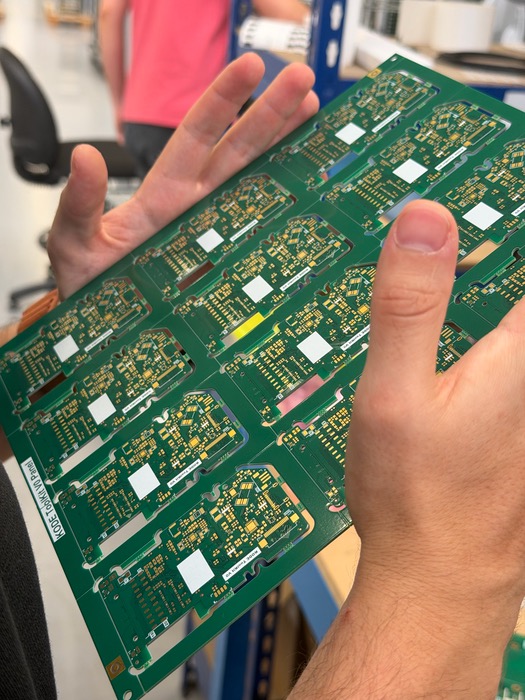
Each panel went through the SMT line, where hundreds of components per board are placed and soldered in minutes. Out the other end came finished main PCBs, ready for the part that decides everything: proving they work.
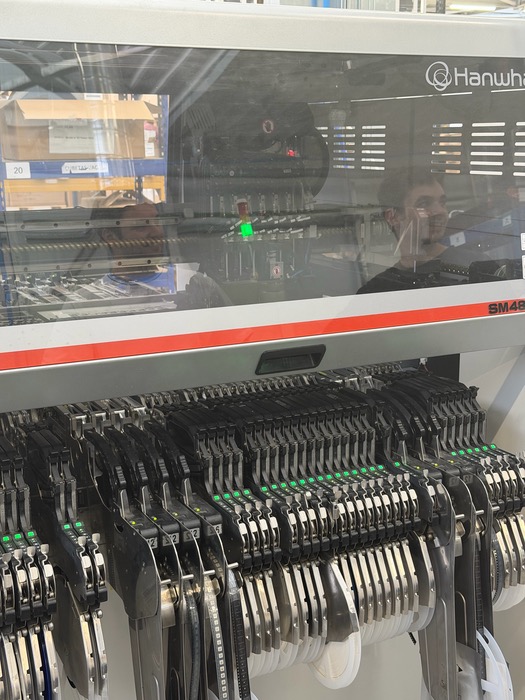
Validated block by block: everything works at 100%
Assembled is not the same as working; a board fresh off the line has promised nothing yet. So we treated bring-up like the exam it is: schematic on one screen, oscilloscope on the other, every block powered up and measured, one by one. No block gets a pass because the one next to it behaves.
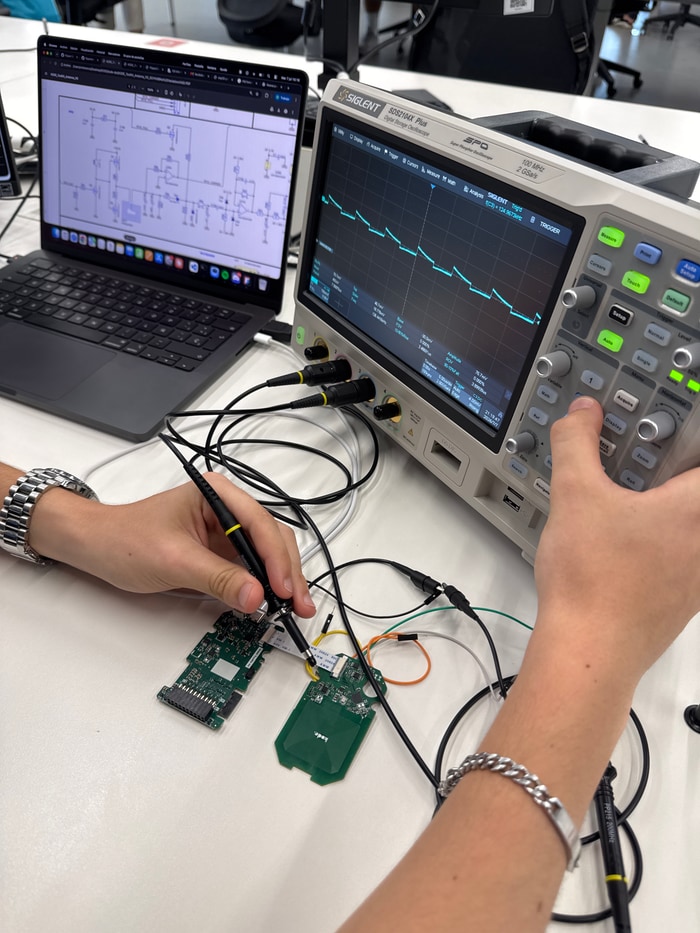
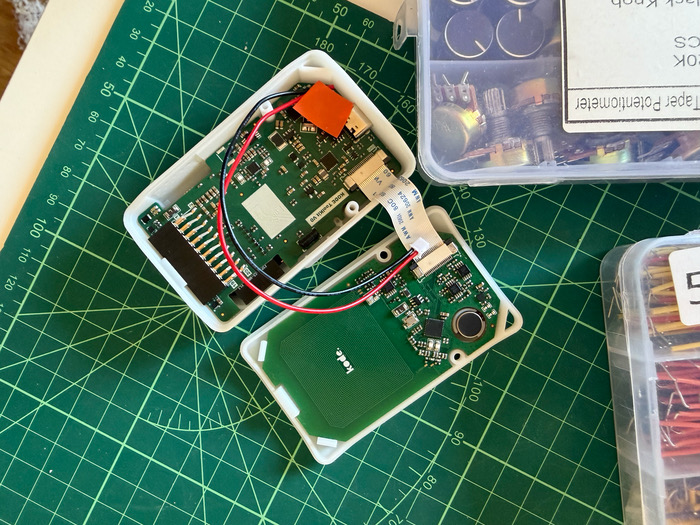
Every subsystem checks out. Add the antenna PCB, validated in the previous round, and that is the complete Kode Dot electronics running on the bench. No simulations. No dev boards. The real thing.
What changed since the prototype
This is the part we are most proud of. We could have frozen the prototype's electronics and shipped them; nobody would have blamed us. We didn't, because moving to production was one last chance to push nearly every subsystem further. We took all of it:
- Display moved from QSPI to MIPI, so the UI is faster and smoother.
- Audio now runs on the ES8311 codec.
- IR emitters and receiver are implemented.
- NFC with the ST25R3916B, plus a discrete analog front-end for 125 kHz RFID.
- A haptic vibration motor.
- New brains: the ESP32-P4 with 32 MB of flash and 32 MB of PSRAM, with an ESP32-C5 as the wireless co-processor. It brings Wi-Fi on 2.4 GHz and 5 GHz plus support for Matter, Zigbee, Thread, ESP-NOW and more.
Smaller changes that matter
Some upgrades never make the spec sheet but change how the device feels every day. The top header now accepts modules facing either side. The camera works facing front or back. And every peripheral can be switched off individually, so the whole device drops into a true low-power mode and the battery lasts far longer.
A look of our own
The boards were not the only thing that matured. Kode Dot kept getting compared to other devices, and we refuse to live as "the alternative to X". So alongside the electronics we refined the design, the colors and the identity of the product until it was unmistakably ours.
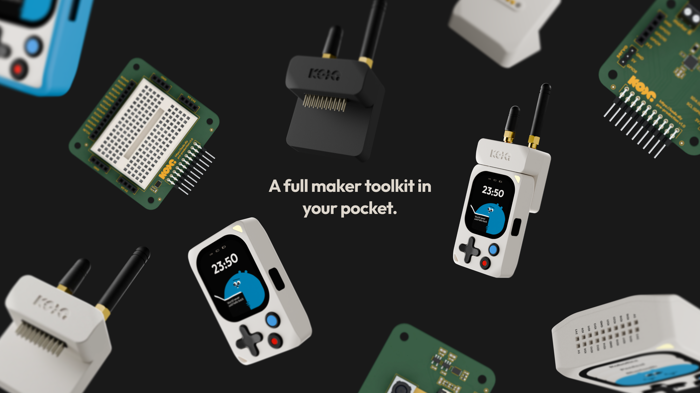
Did all of this move the schedule? Yes. And we would make the same call again, because the bar has not moved since day one: the device that ships has to be the best one we can possibly build. Same promises, better hardware.
The Kode Dot is available for pre-order while production continues.
First shared with our backers in the Kickstarter update of July 8, 2026.