Product updateApril 24, 2026
Kode Dot Hacking Module Revealed: Sub-GHz, Wi-Fi 6 and GNSS Specs
Kode Dot is a pocket-size, open-source device for makers, hackers and geeks: a handheld you can program, extend with modules and use to talk to the electronics around you. Alongside the device itself we are building a family of expansion modules, and one of them was shaped directly by a backer survey: the pentesting module.
That module now has final specs, chip by chip. It is the headline of this update, together with a roadmap you can check in real time and an apology we owe you.
What Goes Inside the Pentesting Module
This module did not start from a spec sheet. It started from a survey we ran with our backers a few months ago, asking which tools they actually wanted to run. We designed the radio hardware around those answers.
These are the final specs.
- Sub-GHz, 300 to 928 MHz: a CC1101 with 3 dedicated bandpass filters per band, 2 SP3T switches toggling in sync and an internal antenna. For cloning garage remotes, barriers and doorbells, replay attacks, spectrum sweeps and raw analysis of unknown IoT protocols. We are still deciding between a spring antenna and integrating it directly into the PCB for better performance.
- Dual nRF54L15: two independent pre-certified 2.4 GHz radios. One carries an integrated antenna and the other an external SMA antenna, to maximize isolation between the two chips. For auditing the security of your own BLE or Zigbee network, analyzing the traffic of your home IoT devices, studying how proprietary 2.4 GHz protocols work and running radio coexistence tests.
- ESP32-C5-MINI-1U-N4T2: a dedicated dual-band 2.4 and 5 GHz Wi-Fi 6 radio, independent from the system, with an external whip antenna via SMA. It runs Marauder, deauth, Evil Twin, beacon flood, PMKID capture and monitor mode with packet injection without breaking the kodeOS Wi-Fi connection. Marauder was the most mentioned tool in the survey.
- Multi-constellation GNSS: a Quectel LC76G-PA receiver covering GPS, GLONASS, Galileo, BeiDou and QZSS, with an SMD chip antenna integrated into the PCB. For wardriving with automatic geotagging of every captured network, forensic timestamps with atomic UTC time on .pcap captures, and fox hunting by RSSI trilateration with GPS coordinates.
One line we will not blur: all of this exists for educational use, in a controlled environment, on networks and devices that are yours. Never, under any circumstances, for anything that is not 100% legal. Just to be clear.
Hacking Module or Pentesting Module?
We are also debating the name. "Hacking Module" is what we called it during the campaign; "Pentesting Module" is closer to what it actually is, a tool for auditing wireless systems you are allowed to touch. That one is genuinely up to the community.
A Roadmap You Can Check in Real Time
On Kickstarter we committed to two dates: mass production in March, and start shipping in July. We did not make March, and we are not going to make July either.
The reasons are the ones we have been covering in previous updates: finding a production partner, adding new features to the Kode Dot, locking in the mechanical partner and the branding partner. Those are processes that take months inside big organizations. We condensed them into less than 4 months, and they are the foundation everything else stands on.
Rather than announce a new date and ask you to trust it, we published the plan itself at timeline.kode.diy. It is the same process timeline we use internally, live: phases that are already closed, like the Kode Dot schematics, and phases we are in right now, like PCB routing and the first production prototype.
Following that plan, we would start mass production at the beginning of August and ship the first batch in September. Feedback to improve the timeline is welcome; the goal is to add the risks and the goals of each phase so you can read it the way we do.
The Part We Got Wrong
We have been heads-down on production, logistics, certifications and growing the team, and in the process we stopped showing you the work. On a Kickstarter, transparency and trust are part of what you paid for, and we let that slide. We are sorry, and we are fixing it.
Concretely: we are moving to two updates per month, one mid-month and one at the end of the month. Some of you also flagged repetitive ads from us on social media, which came from neglecting our relationship with the marketing agency. That is being corrected too.
Where the Hardware Stands
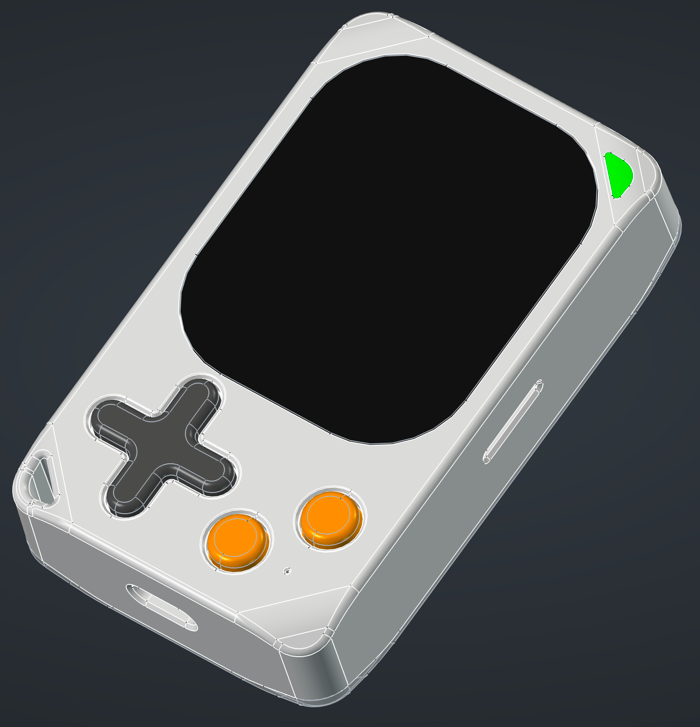
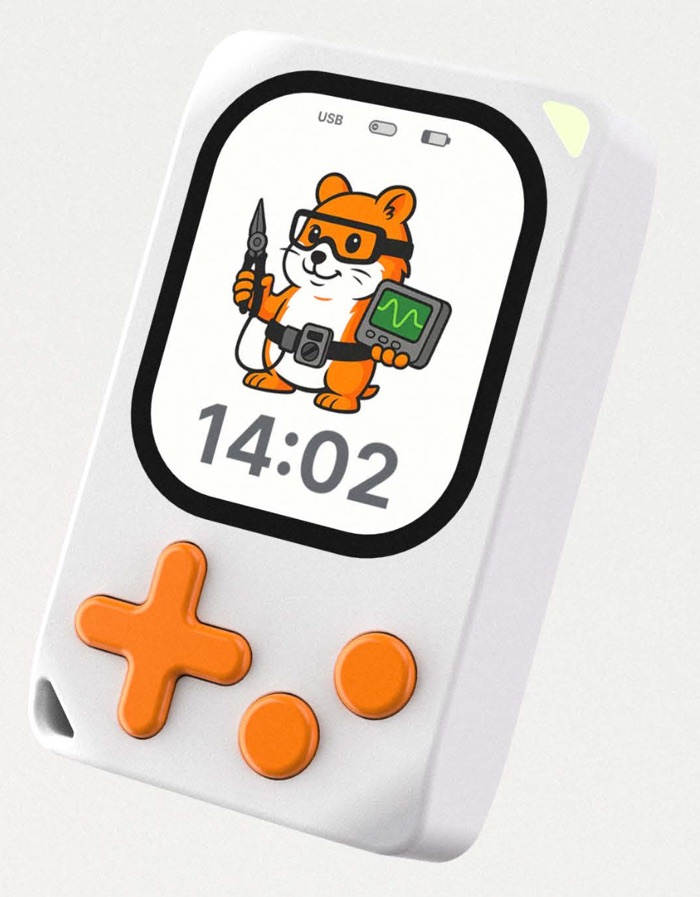
With the schematics closed, these past weeks went into the device layout and matching it against the mechanical design and assembly.
The board is a rigid-flex-rigid design. The main PCB carries the core components, and a flex section routes signals to the antenna PCB, where the NFC/RFID antenna and the ICs that drive it live. Between them sits a plastic piece that holds everything together and houses the battery, the haptic vibration motor and the speaker.
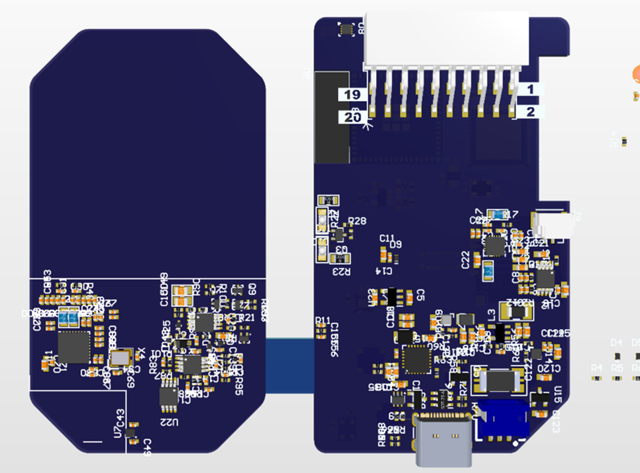
It is a first version and there is still plenty of work on it, but we expect to close it in two weeks. The mechanical design is moving at the same pace, with the first prototypes targeted for mid to late May.
The RF Module Got Faster
The Meshtastic-focused RF module improved as well. We moved the LoRa radio from the LR1121 to the LR2021, a new generation that allows much faster LoRa speeds, with the idea of being able to transmit voice. And the GNSS went from the MAX-M10S to the LC76GPAMD: same performance, with more community support and Meshtastic integration.
Designed to Certify Fast
Everything is designed with certification in mind. Our main targets are CE (Europe) and FCC (United States), the two most demanding regulations and the ones that open the door to the vast majority of our backers. That is why both the Kode Dot and the expansion modules use pre-certified modules from the start: we inherit a big part of the testing and cut time and cost out of the process.
None of this is the fastest way to ship. It is the way that ends with the device we promised, which is the only bar that has ever mattered here. The Kode Dot is available for pre-order while the work continues.
First shared with our backers in the Kickstarter update of April 24, 2026.