CompanyJanuary 7, 2026
The Kode Dot Kickstarter Story: Funded in 5 Minutes, Shaped by 16,144 Backers
Kode Dot is a pocket-size, open-source device for makers, hackers and geeks: a handheld you can program, extend with modules and use to talk to the electronics around you. Before it was a product in production, it was a Kickstarter campaign. This is the story of that campaign, and of how the people who backed it changed the hardware itself.
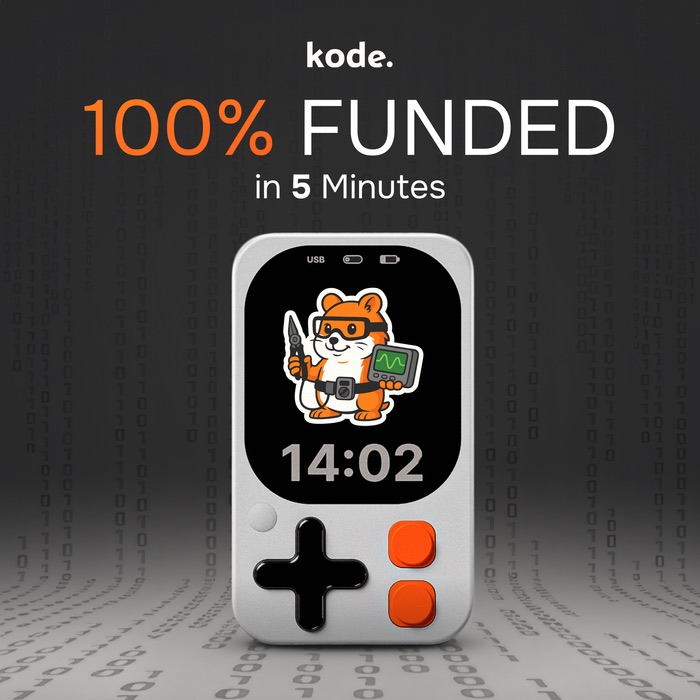
Funded in 5 minutes, on a 4,387 euro goal
On November 5, 2025 we launched on Kickstarter asking for 4,387 euros. The campaign was funded in 5 minutes.
Kode Dot had started as a weekend project between friends, trying to answer a simple question: how do you build and test ideas anywhere, without a desk full of wires? Five minutes after launch, that weekend project had a community. The next day, Kickstarter added its own signal and awarded the campaign the Project We Love badge.
The stretch ladder the community reordered
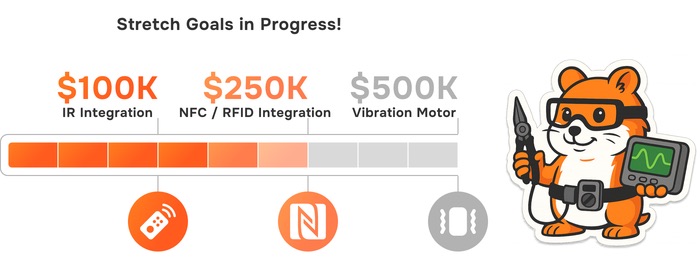
With the goal met on day one, stretch goals became the campaign's real plot. The first rung fell on November 11: the $100K goal unlocked a built-in IR transmitter and receiver for every unit, no add-ons needed. That same update carried the first outside signals, a first review by Volos Projects (115K subscribers) and a feature on Hackster.
Then the comments took over. NFC kept coming up, often enough that we sat down and reordered the remaining goals: NFC and RFID moved up to $250K, and the vibration motor took the $500K spot. The new ladder was a direct result of backer feedback, and it set the pattern for the rest of the campaign: this community was not just funding the device, it was speccing it.
$250K: NFC for everyone, and a new module appears
On November 26 the campaign crossed $250K and one of the most requested goal unlocked: NFC and 125 kHz RFID, built into every unit, free. The device now covered both the low-frequency and high-frequency ranges out of the box.
The same update introduced something new: the Hacking Module, a compact add-on for Wi-Fi analysis, Sub-GHz exploration and controlled pentesting experiments. As revealed back then, it packed an ESP32-C5 with 2.4 GHz and 5 GHz Wi-Fi, full-band Sub-GHz coverage and an NRF24 radio. The module grew far beyond that first render; the final pentesting module design has its own story.
$500K: haptics, and the first working prototypes
On December 8 the total passed $500,000 and the built-in vibration motor was unlocked. Every milestone so far had added a radio or a sensor; this one added feel.
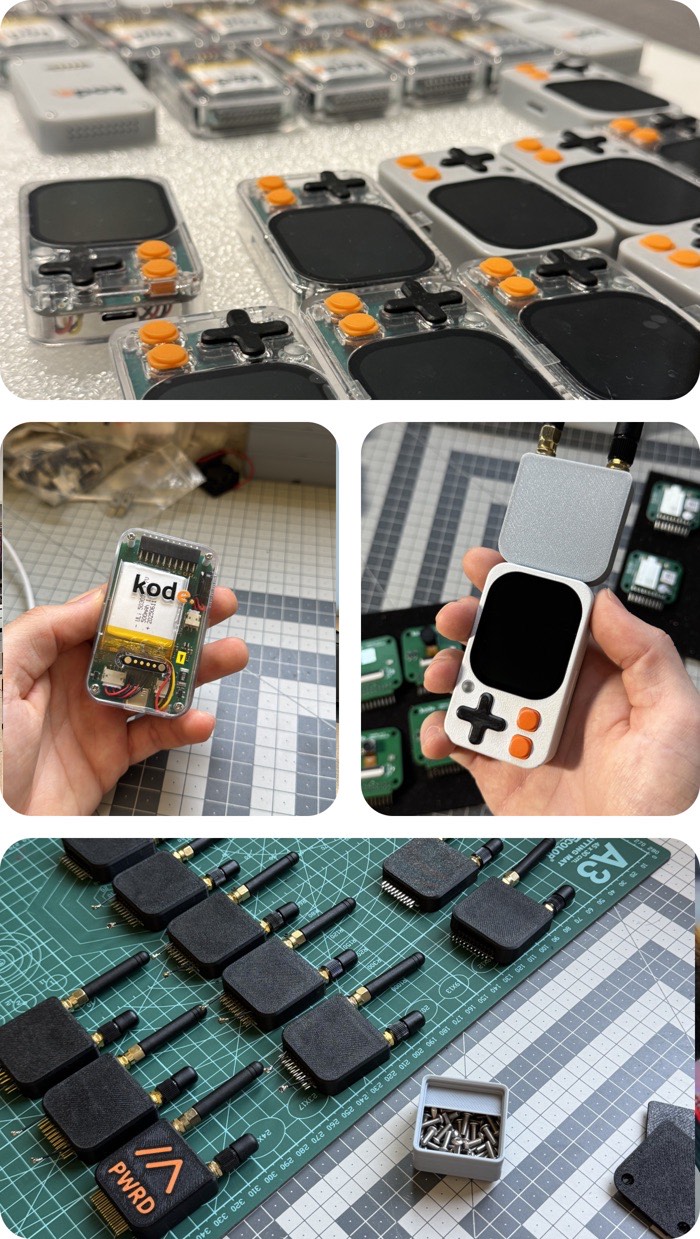
The same update carried a quieter milestone: the first working prototypes were in our hands, and the team was testing core functions and stress-testing components build after build. We wrote back then that we would not rush the process, because the final product had to be something we were genuinely proud to put in your hands. That bar has not moved since.
$1M: two chips instead of one
Three days later we introduced the goal we had wanted to announce for a long time. At $1M, Kode Dot would move to a dual-architecture system: an ESP32-P4 handling the heavy lifting, with an ESP32-C6 managing connectivity and power efficiency.
The campaign copy of the time promised a dual-core RISC-V processor at up to 360 MHz; the newer P4 silicon we ship today runs at up to 400 MHz. On December 17 the community crossed $1,000,000 and the upgrade locked in, for every pledge, automatically. Nobody had to pay to upgrade; the device everyone had already backed simply got better.
$2M: missed at the wire, unlocked anyway
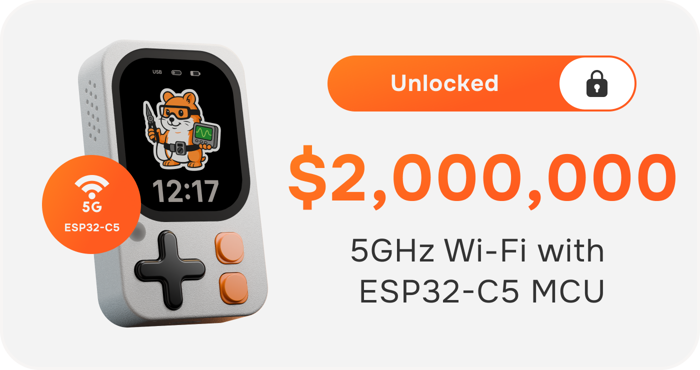
One goal remained. At $2,000,000 we would swap the ESP32-C6 for the ESP32-C5, bringing dual-band Wi-Fi 6 on 2.4 GHz and 5 GHz into the base device, a capability that until then was exclusive to the Hacking Module.
The live campaign closed on December 23, 2025 just short of the mark. But late pledges kept counting, and on January 7, 2026 we confirmed it: the $2M stretch goal was unlocked, and the ESP32-C5 upgrade applied to everyone, exactly as it would have during the live campaign.
What 16,144 backers built
The final tally: 2,943,475 euros pledged against a 4,387 euro goal, from 16,144 backers. In the closing update we also confirmed that production would take place in Europe, to keep quality control tight.
But the number we keep coming back to is the ladder itself. IR, NFC, 125 kHz RFID, the vibration motor, the ESP32-P4 and the ESP32-C5 are not campaign promises anymore; every one of them is physically present on the validated production boards. The community raised the hardware, milestone by milestone, and our job since then has been to build it to the standard that effort deserves.
The device all of this became is available for pre-order while production continues.
First shared with our backers across the ten campaign updates, from the Kickstarter update of November 5, 2025 to the Kickstarter update of January 7, 2026.